Science For Sustainable Impact: Issue 2, February 2026
Science for Sustainability Impact
About the Author: How Education, Experience, and Context Shape My Approach to Impact
Barbara Amoah, PhD, PMP
Scientific Consultant | Educator | Sustainability & Systems Thinker
February 1, 2026
Editor’s Note: How My Path Shapes This Newsletter
Readers often ask how my work came to sit at the intersection of science, sustainability, education, and applied programs.
The short answer is that it wasn’t a single decision or role. It was shaped over time by where I grew up, how I was trained, the institutions where I’ve taught, and the kinds of projects that consistently revealed where impact holds up and where it breaks down.
This issue offers a bit of that context, and a window into why this newsletter focuses so much on the gap between strong ideas and real-world impact.
Growing Up: Noticing Systems Before I could Name Them
Before I had formal language for sustainability or systems thinking, I was already paying attention to how environments, resources, and decisions shaped everyday outcomes.
Growing up, I learned that effort alone did not always determine success. Timing, access, incentives, and constraints often mattered more than intention, a realization that stayed with me long before I entered formal scientific training.
I grew up in a farming community in Ghana, where food production, livelihoods, and community well-being were closely intertwined. I saw both the potential of agriculture to sustain families and the challenges farmers face when resources, knowledge, or infrastructure are limited. Those experiences grounded my interest in agriculture as a tool for food security and ultimately led me to pursue agricultural sciences at the highest level I could. They also continue to shape how I think about the kinds of tools, frameworks, and questions that are most useful to people working on sustainability in real systems, not just in theory.
Education: What Science Taught Me About Real Systems
My formal training is in applied science, with a foundation in entomology and pest management. My education across institutions, including the Kwame Nkrumah University of Science and Technology (Ghana), University of Greenwich (England), and Kansas State University (United States), emphasized scientific rigor, experimental design, and evidence-based decision-making within complex biological and agricultural systems.
That training was essential, but it also revealed an important limitation. Controlled environments let us to isolate variables and test solutions; real-world systems do not. Social behavior, markets, policy, environmental variability, and uncertainty all interact with biological processes in ways that challenge clean, linear solutions. Understanding that tension became central to how I think about sustainability and impact.
Science resonates most when people can see their own constraints in it.
Teaching: Where Theory Meets Real Constraints
Teaching has played a major role in shaping how I approach impact.
My teaching experience has spanned courses such as Ecoliteracy for a Sustainable World, Integrated Pest Management (IPM), Climate-Smart Agriculture, and other life sciences– and agriculture-focused courses across multiple institutional contexts. In these settings, I have worked with students who often balance education alongside professional and community responsibilities.
Teaching across institutions including Unity Environmental University, the University of North Carolina at Greensboro, South Carolina State University, and North Carolina A&T State University consistently reinforced the same lesson: learning is most effective when scientific concepts are clearly connected to real-world systems and decision-making environments.
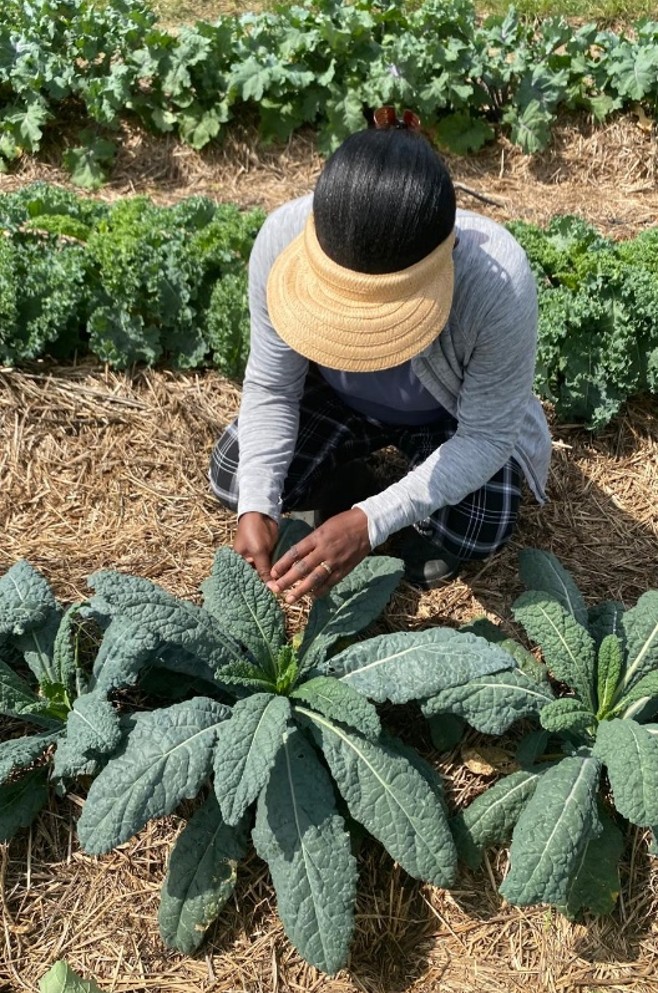
Across these classrooms, the emphasis has been less on content delivery and more on translation, helping students understand how biological, ecological, and agricultural principles operate within social, economic, and institutional constraints. Whether working with traditional undergraduates or nontraditional learners, I have seen that engagement deepens when science is framed not as abstract knowledge, but as a tool for understanding and navigating complex systems.
That pattern has held across disciplines and institutions, and it continues to shape how I think about sustainability, education, and impact. When learners can see their own experiences, constraints, and goals reflected in scientific frameworks, the knowledge is more likely to persist and to be applied beyond the classroom.
Applied Work: Where Solutions Meet Real Constraints
Alongside teaching, applied and community-based projects repeatedly reinforced the same lesson. Across work in food security, post-harvest systems, climate adaptation, and sustainability education, I’ve seen that durable outcomes emerge when scientific insight meets contextual understanding.
Take agriculture: reducing crop loss isn’t just technical. Adoption hinges on who makes decisions, seasonal pressures, perceived risk, and economic tradeoffs.
Often, the most effective solutions aren’t the most complex, but the ones people can understand, adapt, and sustain within their existing decision and resource constraints.
The problem is rarely the evidence; it is often the system surrounding it
Consulting: Where Grants Meet Real Implementation
My consulting and grant writing work adds another layer to this perspective. I support organizations across sectors with grant strategy, program design, and implementation planning. This gives me a front-row seat to how scientific ideas become funded initiatives and how early design choices determine whether impact survives after grants end.
This work reinforces one truth: Alignment matters between evidence, feasibility, timelines, and the systems that must carry interventions forward. To date, I’ve helped clients secure over $30M in funding across research, innovation, and implementation projects spanning device development, agtech, crop protection, robotics, and engineering from federal sources including USDA, NSF, NIH, ARPA-H, and DoD. Each one sharpens my understanding of design choices that drive or kill long-term impact.
Featured Project: Towards Zero Hunger Project
Looking ahead, I’m continuing this integration work through a community-based initiative in Ghana supported by the Commonwealth Alumni Engagement Fund (ACEF). The project, launched in November 2025 in two farming communities, aims to reduce post-harvest losses and strengthen sustainability outcomes within maize value chains.
The next phase emphasizes not just technical solutions, but also adoption, local capacity, and long-term viability. This ensures scientific insight aligns with the realities that determine whether impact persists beyond the project period.
(I’ll share more details and lessons from the project in future editions.)
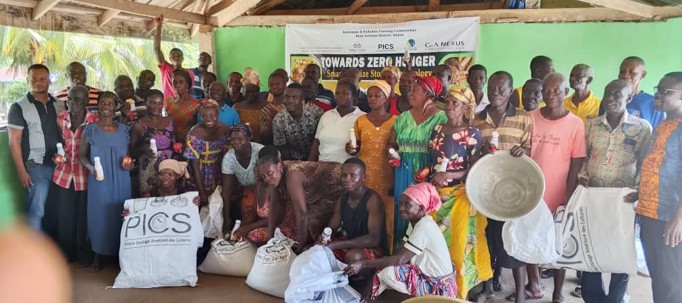
This project launch brought together participants around a shared goal: translating evidence into approaches communities can adopt and sustain.
Why This Newsletter Exists
Science for Sustainability Impact exists to explore how knowledge moves from evidence into action — and what strengthens or weakens that journey.
I focus less on case studies, more on patterns across contexts:
- Why some ideas create durable impact
- Why others stall despite strong evidence
- How context, incentives, and systems shape outcomes
My goal: practical language, patterns, and questions for anyone working to turn scientific knowledge into meaningful, sustained impact.
February Engagements
I’m a panelist at Interchange26, a three-day (February 3 - 5) conference bringing Commonwealth Scholars and Alumni together to explore fair trade, equitable business, and social enterprise solutions to global challenges.
I will join other research, policy, innovation, and implementation leaders in discussing “Breaking Barriers: Women and Marginalised Voices in Social Enterprise”. Such conversations directly shape this newsletter, where scientific knowledge gets strengthened through real exchange across disciplines and decision contexts.
I’ll share key insights from Interchange26 in the next edition.
Join the Conversation
If you work in research, education, policy, industry, or implementation and you’ve seen strong ideas struggle against real-world systems, this space is for you.
Resonate with this perspective? Subscribe and or share with someone at the science–implementation interface
Thank you for reading and building this community with me!
Science for Sustainable Impact Newsletter is published monthly on the first of each month. Subscribe here.