Science For Sustainable Impact: Issue 4, April 2026
Photo Courtesy: mannlakeltd.com
April 1, 2026
Barbara Amoah, PhD, PMP
A Three-Part Series: Balancing Pest Control and Pollinator Protection
Have you ever wondered how insecticides designed to protect crops can also impact the insects that support agricultural systems?
This three-part series explores the intersection of crop protection, pollinator health, and decision-making in agriculture. It begins with the science of risk, then in May, we will examine trade-offs. Finally in June, we will take a look at integrated approaches to reduce risk while maintaining productivity.
Neonicotinoids are among the most widely used insecticides in modern agriculture, valued for their effectiveness against piercing-sucking pests such as aphids, whiteflies, and certain beetles. Commercially available products containing active ingredients such as thiamethoxam or imidacloprid are commonly applied as seed treatments, soil drenches, in-furrow applications, or foliar sprays across crops including corn, vegetables, fruits, and ornamentals (University of Wisconsin-Madison Extension).
Their effectiveness is closely tied to their ability to move systemically within the plant.
Neonicotinoids are also recognized and regulated as a distinct class of systemic insecticides by agencies such as the Washington State Department of Agriculture, reflecting both their widespread use and the need for careful management within agricultural systems.
At the same time, concerns about their environmental and health impacts continue to grow. Ongoing assessments by the National Toxicology Program are evaluating the potential health effects of neonicotinoid exposure, reflecting increasing scientific attention to their broader impacts beyond target pests. Broader public and scientific discourse, supported by ongoing research and extension efforts, has highlighted the complexity of balancing agricultural productivity with pollinator protection.
How Neonicotinoids Move Through Plants
After application, neonicotinoids are absorbed through plant roots and transported throughout the vascular system. This allows the insecticide to protect the plant from within, reaching leaves, stems, and new growth.
However, this same systemic movement also means that residues can appear in pollen, nectar, and Guttation fluids. This creates unavoidable exposure pathways for non-target organisms, particularly pollinators.
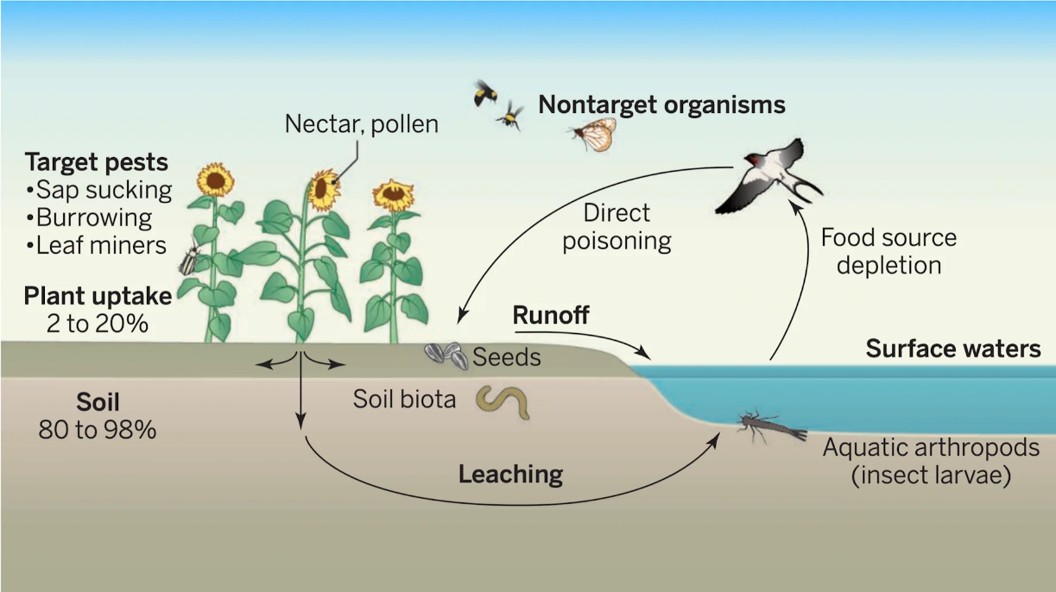
Importantly, only a small fraction of the applied product, typically 2-20%, is taken up by the plant. The remainder persists in the soil or moves into surrounding environments, including nearby vegetation and water systems (University of Wisconsin-Madison Extension).
Pollinator Exposure: Beyond Direct Application
Pollinators are not exposed to neonicotinoids only through direct application.
Exposure can also occur through:
- consumption of contaminated nectar and pollen,
- contact with residues in wildflowers near treated fields, and
- movement of residues through soil and water.
Because pollinators forage across wide areas and repeatedly visit multiple plants, even low-level residues can result in chronic exposure at the colony level.
Toxicity, Exposure, and Environmental Persistence
Neonicotinoids act on the insect nervous system by binding to nicotinic acetylcholine receptors, leading to paralysis and death at sufficient doses.
For pollinators such as honey bees, acute oral median lethal dose (LD50) values are extremely low-approximately 1-5 ng per bee (National Toxicology Program). However, the greater concern lies in sublethal exposure, which can impair navigation, foraging behavior, learning and memory, immune function, and queen longevity. While these effects may not immediately kill individual bees, they can weaken colonies over time and reduce overall resilience.
Neonicotinoids are also highly water-soluble and persistent, allowing them to move beyond the point of application. They can enter nearby streams and groundwater, accumulate in non-target plants such as wildflowers, and remain in the environment beyond the initial application period. Research and extension analyses, including those from the University of Wisconsin Extension, highlight how these compounds can become distributed across entire agricultural landscapes rather than remaining confined to treated crops.
This widespread movement contributes to chronic, low-level exposure. Residues have been detected in honey and environmental samples across multiple regions, reinforcing the extent to which pollinators are exposed through multiple pathways.
Pollinators contribute to the production of crops valued at hundreds of billions of dollars globally, underscoring the importance of maintaining pollinator health alongside crop protection efforts.
What This Means
Neonicotinoids are effective because they are systemic, persistent, and broadly active against insect pests. But these same properties also make them difficult to confine to target organisms.
The challenge is not simply toxicity; it is exposure across complex systems. Pollinators cannot detect low-level residues. They forage across treated and untreated areas and end up transporting contaminated resources back to colonies. As a result, exposure is not limited to individual insects, but it is amplified through ecological interactions.
Looking Ahead
Understanding the risks associated with neonicotinoids is only one part of a much broader conversation. Despite well-documented concerns, these products remain widely used in agricultural systems. This reflects a more complex reality where pest pressure, crop protection needs, and economic considerations continue to shape decision-making.
So why do producers continue to rely on neonicotinoids, even as concerns about pollinators grow?
In the next issue, we will examine the practical realities behind their use by exploring the trade-offs that farmers, researchers, and regulators must navigate in balancing productivity with environmental risk.
From there, the conversation shifts to a critical question:
What does a path forward look like?
The final issue in this series will focus on how Integrated Pest Management (IPM) can help reduce reliance on high-risk inputs while maintaining effective pest control.
Let’s Continue the Conversation
Where do you think the greatest risk to pollinators occurs:
- direct application on crops,
- movement into surrounding environments, or
- chronic, low-level exposure over time?
References
- National Toxicology Program. Neonicotinoid pesticides & adverse health.
- Purdue University Extension. Neonicotinoid insecticides and their effects on pollinators (POL-4)
- Sanchez-Bayo, F. (2014). The trouble with neonicotinoids. Science. 346. 806-807. 10.1126/science.1259159.
- University of Wisconsin-Madison Extension. Neonicotinoid insecticides: Widespread use and emerging impacts on agricultural landscapes.
- Washington State Department of Agriculture. Neonicotinoids - Restrictions on certain uses of neonicotinoids.
#CropProtection #Pollinators #Neonicotinoids #Agriculture #FoodSecurity #SustainableAgriculture
#EnvironmentalScience #RegulatoryScience #PesticideRegulation #AgPolicy
Science for Sustainable Impact Newsletter is published monthly on the first of each month. Subscribe here.